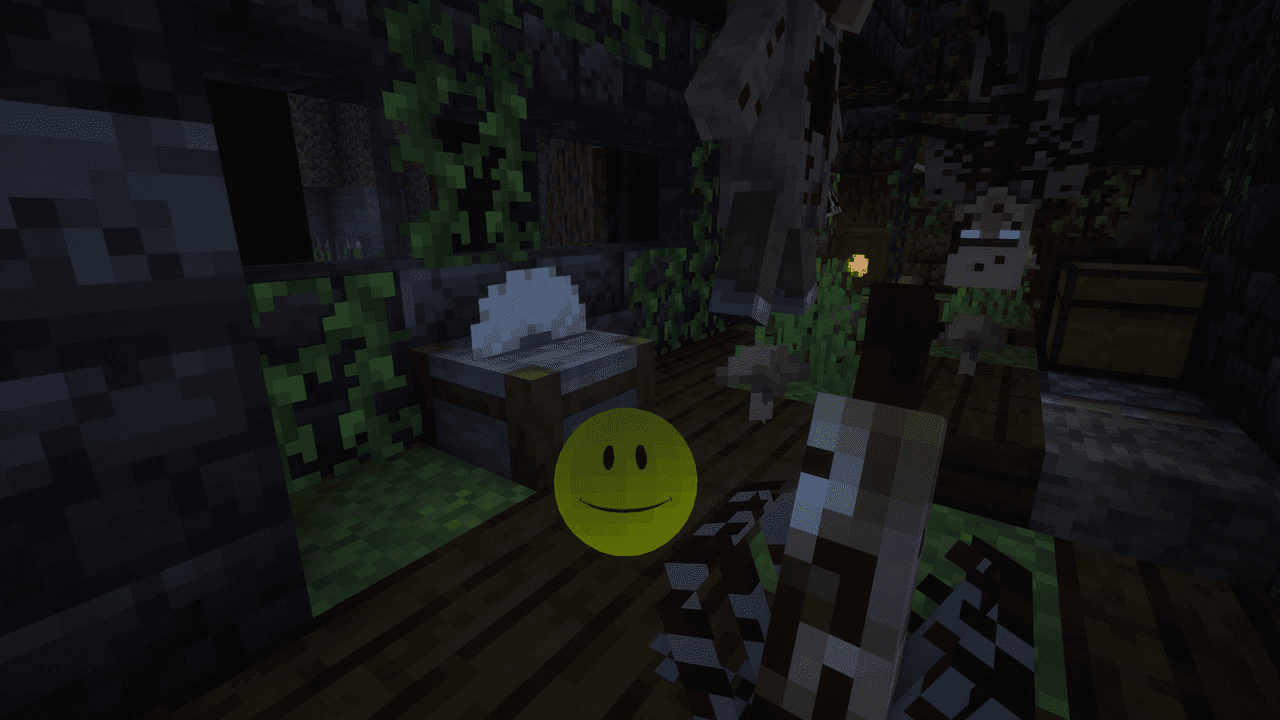
Verity mod lore: documented facts and community claims
Search results for Verity mod lore often mention characters, forms, locations, or a yellow ball. The public Verity-CE repository reviewed by this site does not currently include an official lore document, story index, character guide, or cited transcript that can verify those summaries.
Rather than turn repeated community claims into facts, this page explains what is documented and how to evaluate lore evidence when you find it.
What the public project documents
The Verity-CE README documents a community edition, its relationship to a decompiled Verity 2.1.0 build, Minecraft 1.21.1 adaptation, configurable AI and speech services, and several technical fixes. Those are project and implementation statements.
The README does not explain a canon story, identify a yellow ball, define a Lab, list story systems, or describe a monster form. The release page also does not provide a lore guide. This site therefore cannot present those details as verified canon based on the current public sources.
Why lore summaries disagree
Game and mod lore can come from dialogue, in-game events, source files, creator posts, release notes, community videos, roleplay, or fan interpretation. These sources do not all carry the same weight.
A video can show what appeared in one build without proving that the event exists in every release. A source-code identifier may be an internal name rather than a narrative statement. A community wiki can summarize observations accurately, but it remains secondary evidence unless it links to the underlying material.
Different Verity builds may also contain different assets or behavior. A claim observed in an original build should not automatically be assigned to Verity-CE, and a community-edition change should not be presented as original canon.
How to verify a character or event claim
Record the exact build, Minecraft version, loader, and source of the file. Then preserve the evidence itself: an unedited recording with context, an exact dialogue transcript, a release note, a creator statement, or a stable source-code reference.
Ask four questions:
- Does the evidence identify the build and version?
- Is the event reproducible, or could it be edited, scripted, or from another project?
- Does a primary source explain the event, or is the explanation a viewer's interpretation?
- Does the claim still apply to the current release?
A repeated phrase across many copied pages is not independent confirmation if all pages ultimately rely on the same uncited video or post.
What about the yellow ball?
The phrase appears in user searches, which shows that people associate it with Verity. Search demand alone does not establish the character's official name, role, behavior, or story. The current public repository lacks a cited lore source that would let this site answer those details confidently.
If the project publishes a transcript, story document, creator statement, or reproducible release containing that material, this page can be updated with direct citations. Until then, detailed descriptions should be labeled as community interpretation rather than project documentation.
Historical claims readers may encounter
Older pages and search snippets have described Verity as a yellow ball, mentioned a location called the Lab, referred to a monster form, and listed eight systems with names such as Dynamic AI, Progressive Horror, Voice Synthesis, Facial Animation, Story Engine, Animations, Spatial Audio, and multiplayer awareness.
Those phrases explain why people search for "Verity yellow ball," "who is Verity the yellow ball," "Verity mod lore," or "Verity Lab." They are not verified by the current public Verity-CE README or release page. This guide preserves the vocabulary so readers can identify the claim they found, while keeping the evidence status visible.
| Claim found in older material | Evidence in the current public repository | Status on this guide | | --- | --- | --- | | Verity is a yellow ball character | No cited character or lore document | Community or historical claim | | The Lab is a canonical location | No cited map, transcript, or story index | Unverified | | A monster form appears after a trigger | No cited release note or reproducible sequence | Unverified | | The project has eight named story systems | The README documents technical API, speech, version, and bug-fix work, but not this eight-system list | Unverified as a lore framework |
This table does not say that an event never existed. It says the sources reviewed here cannot currently establish the claim for the release they document.
A useful way to discuss uncertain lore
Separate observation from interpretation. For example, "a player recorded a yellow object appearing in build X" is an observation if the recording is authentic and contextualized. "The object represents Y and controls Z" is an interpretation unless dialogue, documentation, or the creator confirms it.
This distinction does not make community discussion less interesting. It makes the boundary visible so readers can decide how much confidence to place in each claim.
Keep original and community builds separate
The current README describes Verity-CE as a community-maintained edition based on a decompiled Verity 2.1.0 build. That relationship can make lore attribution difficult. Code or assets inherited from an earlier build, behavior added by the community edition, and explanations written by players are three different evidence categories.
When documenting an event, write the exact release tag and source beside it. Avoid saying "the Verity mod always does this" when the observation came from one file or one video. A version-specific statement is both more useful to players and easier to correct when the project changes.
A practical lore evidence record
For an in-game observation, keep the unedited recording, Minecraft version, loader, release tag, world or test conditions, and timestamp. If dialogue is involved, include the exact line and the surrounding exchange. If the observation depends on an API-backed feature, note the provider and model without exposing credentials.
For a creator statement, link to the original post rather than a screenshot of someone quoting it. For source-code evidence, link to a stable commit and explain whether the identifier is user-visible or only an internal implementation name. For a community theory, label it as a theory and link to the observation that inspired it.
Submit better evidence
Useful evidence includes a stable public URL, build identifier, date, exact timestamp, and enough surrounding context to rule out a different mod or edited sequence. Do not submit private messages, personal information, copyrighted files, or API keys.
This independent guide will update factual lore only when the source can be checked by readers. It will not convert popularity, repetition, or a generated summary into canon.
Sources and related guides